

Setting up a probiotics manufacturing plant positions investors within one of the fastest growing and most promising segments of the global health and wellness industry. The sector is supported by rapidly increasing demand across functional foods, dietary supplements, pharmaceuticals, and animal nutrition products. Probiotics are live beneficial microorganisms, including specific bacteria and yeast strains, that provide scientifically recognized health benefits related to digestive health, immune support, and microbiome balance. With rising global health awareness, growing focus on preventive healthcare, and expanding nutraceutical markets across both developed and emerging economies, the probiotics industry offers significant long-term growth potential. As consumers increasingly prioritize digestive wellness, immunity enhancement, and personalized nutrition, investing in a probiotics manufacturing plant project cost report represents a strategic opportunity for entrepreneurs and manufacturers seeking to enter a high-value and globally relevant industry.
Unveiling the World of Probiotics
Probiotics are live microorganisms primarily beneficial bacteria and yeast—that deliver health benefits when consumed in adequate amounts. The most used strains in food, nutraceutical, and pharmaceutical applications include Lactobacillus, Bifidobacterium, and Saccharomyces species. The manufacturing process involves highly controlled microbial fermentation, followed by advanced preservation methods such as freeze-drying or spray-drying to maintain microbial viability and potency.
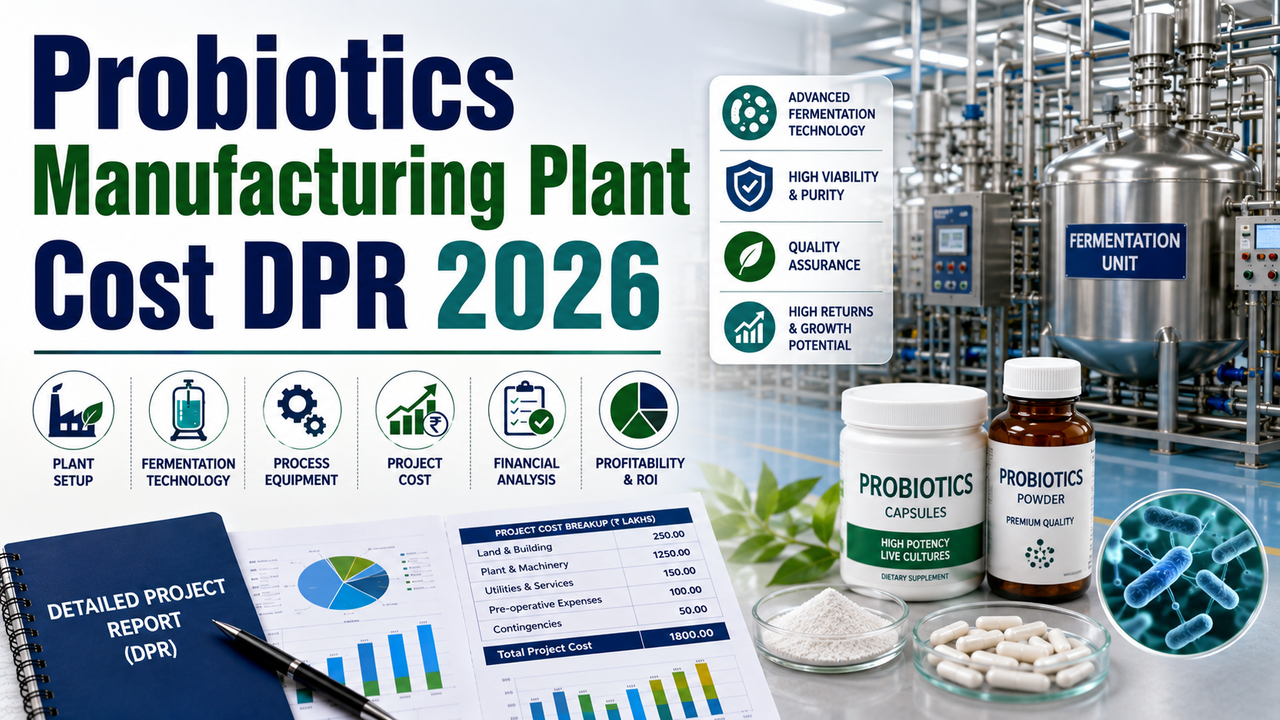
These microorganisms support digestive health, strengthen immune function, improve nutrient absorption, and help maintain a balanced intestinal microbiome. Due to these properties, probiotics have become essential ingredients in functional foods, dietary supplements, and therapeutic formulations. The global probiotics market was valued at USD 71.9 Billion in 2025 and is projected to reach USD 124.0 Billion by 2034, growing at a CAGR of 6.05%, highlighting the sector’s strong commercial and investment potential.
What are Probiotics Used For?
Probiotics are used across a broad spectrum of industries, including food and beverages, pharmaceuticals, dietary supplements, and animal nutrition. In the food sector, they are incorporated into products such as yogurt, kefir, fermented beverages, and a growing range of functional foods. In pharmaceuticals and nutraceuticals, probiotics are formulated into capsules, tablets, sachets, powders, and gummies designed to support digestive health, immunity, and specific wellness applications.
Animal nutrition has also emerged as a major application area, where probiotics are used to improve livestock gut health, enhance feed efficiency, and support disease resistance. The wide-ranging applications of probiotics across multiple industries create diversified revenue opportunities and broad market reach for manufacturers, further strengthening the business potential of establishing a probiotics manufacturing facility.
Plant Capacity and Production Scale:
The proposed manufacturing facility is designed with an annual production capacity ranging between 100 to 1,000 MT, providing operational flexibility across different investment scales. This range enables producers to serve diverse end-use segments across food and beverages, pharmaceuticals, nutraceuticals, and animal nutrition ensuring consistent revenue streams supported by stable and growing global demand. The scalable design allows manufacturers to start with optimized smaller-capacity units and progressively expand as market demand grows, balancing capital efficiency with production volume.
Get the Sample Report: https://www.imarcgroup.com/probiotics-manufacturing-plant-project-report/requestsample
Key Factors for Probiotics Plant Setup Requirements
Establishing a probiotics manufacturing plant requires careful consideration of several key factors that directly impact both the initial plant setup cost and long-term operational profitability.
- Raw Materials and Microbial Strain Supply: The cost and availability of core inputs bacterial strains, fermentation media, cryoprotectants, and excipients are critical. Securing reliable, high-quality strain suppliers and maintaining cold-chain integrity throughout procurement is essential for managing the probiotics manufacturing cost.
- Manufacturing Technology and Equipment: The selection of fermentation systems (batch vs. continuous), centrifuges, filtration systems, freeze-drying or spray-drying equipment, and filling and packaging lines directly influences production efficiency, product stability, and the overall probiotics manufacturing plant cost.
- Environmental Compliance and Approvals: Securing GMP (Good Manufacturing Practice) certifications, food-grade regulatory approvals, and adherence to microbial safety and hygiene standards is essential. Cleanroom facility requirements and controlled fermentation environments add to compliance-related investment.
- Location and Infrastructure: Proximity to raw material suppliers and target markets, along with access to reliable cold-chain logistics, specialized utilities (purified water, clean steam, controlled humidity), and skilled bioprocess technicians, significantly impacts the probiotics manufacturing cost analysis.
Detailed Process Flow and Quality Control
The manufacturing process for probiotics involves a series of precisely controlled biological and engineering operations. Each stage is critical to ensuring the survival, potency, and stability of live microbial cultures through to the finished product.
- Unit Operations Involved: The process includes key stages such as strain selection and seed culture preparation, inoculation, fermentation (batch or fed-batch), centrifugal separation, washing and concentration, cryoprotectant blending, freeze-drying or spray-drying, powder blending, encapsulation or sachet filling, and final packaging under controlled conditions.
- Mass Balance and Raw Material Requirements: Precise mass balance calculations determine the exact quantities of bacterial strains, fermentation media nutrients, cryoprotectants, and excipients required per unit of finished probiotic product, directly influencing the total probiotics manufacturing cost.
- Quality Assurance Criteria: Quality is assessed based on viable cell counts (CFU/g), strain identity verification, moisture content, particle size distribution, and absence of contaminants. Stability testing under defined storage conditions is performed to confirm shelf-life specifications and meet regulatory and commercial requirements.
Buy Report Now: Checkout | Probiotics Manufacturing Plant Cost, Setup, DPR 2026
Cost of Setting Up a Probiotics Manufacturing Plant:
The cost of establishing a probiotics manufacturing plant depends on plant capacity, technology selection, location, automation level, and regulatory compliance obligations. A detailed cost assessment covering both capital and operational expenditure is essential for accurate financial planning.
CapEx and OpEx Analysis for Probiotics Manufacturing Cost:
- Raw Material Costs: As the dominant variable cost, bacterial strains and fermentation media account for approximately 50–60% of total operating expenses. Securing long-term strain supply agreements and optimizing fermentation yields are key strategies for cost management.
- Capital Investment: Initial plant setup costs for fermenters, centrifuges, drying systems, cleanroom construction, filling lines, and cold storage infrastructure represent a significant upfront investment. This is amortized over the plant's operational life to determine unit cost economics.
- Operational Costs: These include fixed costs such as skilled bioprocess labor, maintenance, quality control, and insurance, as well as variable costs including utilities (electricity, purified water, nitrogen), consumables, cryoprotectants, and regulatory compliance expenditures.
- Strain Performance and Yield: The viability, fermentation efficiency, and drying survival rate of the selected probiotic strains directly affect output consistency and per-unit cost. High-performing strains with robust process compatibility improve overall probiotics manufacturing plant economics.
- Manufacturing Capacity: Scale significantly influences unit economics through manufacturing leverage. Larger facilities benefit from lower per-unit capital and operational costs, improving gross margins and the overall return profile of the probiotics manufacturing plant cost.
- Location and Market Conditions: Geographical location influences cold-chain logistics costs, access to cleanroom-qualified labor, and regulatory frameworks. Proximity to pharmaceutical-grade input suppliers and key consumer markets improves the probiotics manufacturing cost analysis.
Why Invest in Probiotics Manufacturing?
Compelling factors:
✓ Strong Consumer Health Focus: The growing global awareness of digestive health, immunity, and preventive healthcare practices is creating sustained and rapidly expanding demand for probiotic products across consumer demographics and geographies.
✓ Value-Added Product Segment: Probiotics generate significantly higher profit margins than conventional food ingredients, with value derived from proprietary strain development, product formulation expertise, clinical substantiation, and strong consumer brand positioning.
✓ Alignment with Health & Wellness Megatrends: Functional foods, nutraceuticals, and personalized nutrition solutions are driving continuous market growth across both developed nations and emerging economies, with probiotics positioned at the intersection of these converging trends.
✓ Regulatory and Healthcare Support: The increasing use of probiotics in clinical and therapeutic contexts for gut health management and disease prevention is building market credibility, expanding adoption channels, and supporting higher product values.
✓ Supply Chain Localization Opportunity: Establishing local production enables manufacturers to ensure product freshness and viability, reduce cold-chain logistics costs, achieve better regulatory traceability, and serve domestic markets with shorter lead times and improved competitiveness.
Ask An Analyst: https://www.imarcgroup.com/request?type=report&id=17886&flag=C
Leading Probiotics Manufacturers
The global probiotics market is served by several multinational companies with extensive fermentation and bioprocessing capabilities, diverse strain portfolios, and broad application coverage across food, pharma, and animal nutrition segments. These manufacturers set industry benchmarks for product efficacy, regulatory compliance, and production scale.
- Arla Foods
- BioGaia
- Hansen Holding A/S
- Danone
- DuPont De Nemours, Inc.
- General Mills, Inc.
- Kerry Group plc
- Lallemand Inc.
- Lifeway Foods Inc.
- Nestle S.A.
- Probi AB
- Yakult Honsha Co., Ltd.
Timeline to Start the Plant
- Feasibility study and project report preparation
- Land acquisition and site development
- Regulatory approvals and GMP certification applications
- Factory licence and fire safety compliance
- Cleanroom design, construction, and validation
- Machinery procurement, installation, and commissioning
- Raw material and microbial strain supplier agreements
- Trial production, quality testing, and stability validation
- Commercial production launch
Licences and Regulatory Requirements
Starting a probiotics manufacturing unit requires several approvals and certifications, which may vary by jurisdiction:
- Business registration (Proprietorship, LLP, or Pvt Ltd)
- Factory Licence under the Factories Act
- GMP (Good Manufacturing Practice) certification
- FSSAI or equivalent food/nutraceutical regulatory approval
- Environmental Clearance from State Pollution Control Board
- GST Registration
- Fire Safety NOC
- Effluent Treatment Plant (ETP) operational clearance
- Occupational Health and Safety compliance
- Phytosanitary and import/export certifications (for international trade)
Frequently Asked Questions:
How much does it cost to set up a probiotics manufacturing plant?
The total setup cost varies depending on plant capacity, chosen technology (freeze-drying vs. spray-drying), cleanroom construction requirements, and geographic location. Costs typically include land, civil and cleanroom construction, fermentation and drying equipment, filling lines, cold storage, pollution control systems, utilities, and working capital. A detailed feasibility report provides accurate, project-specific cost estimates.
Are probiotics manufacturing plants profitable in 2026?
Yes. Probiotics manufacturing offers strong profitability potential with gross margins of 60–70% and net margins of 30–45% under typical operating conditions. Profitability is driven by growing consumer health awareness, premium product positioning, diverse end-market applications, and expanding global demand across food, pharma, and animal nutrition sectors.
What machinery is required for a probiotics manufacturing plant?
Key equipment includes fermenters (stirred tank or bioreactors), centrifuges, crossflow filtration systems, freeze dryers or spray dryers, blending and mixing units, encapsulation machines or sachet filling lines, cleanroom HVAC systems, cold storage facilities, and analytical quality control instruments for CFU counting and strain characterization.
What licences and approvals are required to start a probiotics manufacturing plant?
Typical requirements include business registration, factory licence, GMP certification, FSSAI or equivalent food safety approval, environmental clearance, GST registration, fire safety NOC, and occupational health and safety compliance. Additional quality certifications such as ISO 22000, HACCP, or organic certification may be required depending on target markets and customer specifications.
What raw materials are needed for probiotics manufacturing?
Primary raw materials include selected bacterial strains (Lactobacillus, Bifidobacterium, Saccharomyces, etc.), fermentation media components (glucose, peptone, yeast extract, minerals), cryoprotectants (maltodextrin, skim milk, trehalose), encapsulating agents, excipients, and packaging materials including foil laminates, capsule shells, and sachets.
What are the environmental compliance requirements for a probiotics manufacturing plant?
Manufacturers must obtain environmental approvals, operate effluent treatment systems for fermentation wastewater, comply with air emission standards, and manage biological waste according to biosafety regulations. GMP-compliant cleanroom facilities with controlled microbial environments are also essential to product safety and regulatory compliance.
What is the best location to set up a probiotics manufacturing plant?
Ideal locations offer access to high-purity microbial strain suppliers, pharmaceutical-grade raw material sources, reliable cold-chain infrastructure, skilled bioprocess and quality assurance personnel, and proximity to key consumer markets in food, pharma, or nutraceutical sectors. Areas with established life sciences industrial parks or food processing zones may also offer regulatory and infrastructure advantages.
What is the break-even period for this type of plant?
The break-even period generally ranges from 3 to 5 years, depending on plant scale, product mix, pricing strategy, market penetration rate, and raw material cost management. Facilities with established distribution channels and direct supply agreements tend to achieve break-even faster.
What government incentives are available for manufacturers?
Governments may offer various incentives including capital subsidies, production-linked incentives, tax benefits, reduced utility tariffs, export promotion assistance, and interest subsidies under health sector manufacturing promotion and nutraceutical industry development schemes. Incentives vary by country and region, and dedicated feasibility reports can identify applicable programs for a specific project location.
Contact Us:
IMARC Group
134 N 4th St. Brooklyn, NY 11249, USA
Email: sales@imarcgroup.com
Tel No: (D) +91 120 433 0800
United States: (+1-201-971-6302)


